

If you’ve been on the gluten-free journey for more than five minutes, you know the feeling. You’re standing in the middle of a grocery aisle, eyes squinting at a font so small it should come with a magnifying glass, trying to figure out if “tocopheryl acetate” is going to ruin your week.
It’s exhausting.
I’ve spent the better part of today wrestling with tech issues behind the scenes here at The Wandering Quill, Bluehost, Cloudflare, you name it. It was frustrating, time-consuming, and honestly, a bit draining. It reminded me so much of the early days when Tammy and I were first navigating her Hashimoto’s diagnosis. Back then, every label felt like a landmine. Every bottle of lotion felt like a potential threat.
We’ve all been there: the “Gluten Paranoia Phase.” It’s that time in your journey where you start side-eyeing your dish soap and wondering if your mascara is the reason you’re feeling sluggish.
But here’s the truth: Not all gluten-free labels are created equal. While we need to be vigilant, we don’t need to live in fear. Today, I want to talk about “Gluten-Free Beyond the Kitchen” and introduce what I call the Mouth-Contact Rule. This one simple framework will help you reclaim your sanity and focus your energy on what actually matters for your health.
The Science of the Skin: Why We Can Breathe a Little Easier
Before we dive into the bathroom cabinet, we need to clear up a massive misconception. Whether you are a Celiac warrior or a Hashimoto’s fighter, the biology remains the same: Gluten must be ingested to trigger the autoimmune response associated with Celiac disease.
The gluten protein molecule is actually quite large, too large, in fact, to be absorbed through healthy, intact skin. This means that simply touching gluten or having it sit on your arm isn’t what causes the villi in the small intestine to flatten. The damage happens when gluten enters the digestive tract.
Now, for those of us in the Hashimoto’s community, we often choose a path of stricter avoidance because our bodies are already in a state of high alert. We’re sensitive, and sometimes skin contact can cause topical irritation (like dermatitis herpetiformis or just plain old rashes). However, if we’re talking about the core autoimmune “flare,” the mouth is the gatekeeper.
If you’re just starting out and feeling overwhelmed, you can find some peace of mind in our ↑ 100 Gluten-Free Facts to help separate the myths from the reality.

The “Mouth-Contact Rule”: Your New Priority List
If you control the items that come into contact with your mouth, you have covered 90% of your risk. It’s that simple. Instead of panicking over every bottle in the house, let’s categorize your life based on risk level.
1. Oral-Care Products: The “Red Zone” (High Risk)
This is the most important category outside of the food you eat. Think about it: you put these products in your mouth every single morning and night.
- Toothpaste: We all accidentally swallow a tiny bit of toothpaste. Even if you don’t, the mucosal lining of the mouth is highly absorbent.
- Mouthwash: Same rules apply.
- Dental Floss: Believe it or not, some flavored flosses use ingredients that could contain gluten.
The Strategy: Only buy oral care products that are explicitly labeled gluten-free. This is not the place to “wing it.”
2. Supplements & Medications: The “Hidden Danger” (High Risk)
This is where things get sneaky. Many medications and supplements use “excipients”, basically fillers that hold the pill together. These fillers can be derived from wheat starch. Since you are literally swallowing these pills, this is a high-risk area.
The Strategy: Always check with your pharmacist. Don’t just look at the bottle; ask them to look up the “inactive ingredients” list. For Hashimoto’s patients, thyroid medication itself can sometimes contain gluten fillers, which is the ultimate irony.
3. Makeup: The “Caution Zone” (Moderate Risk)
This is where the Mouth-Contact Rule really shines. You don’t need to throw away your gluten-containing eyeshadow (unless you have a habit of eating it, no judgment here!).
- Lipstick, Lip Balm, and Lip Gloss: These are high priority. We lick our lips, we eat while wearing them, and we inevitably ingest these products.
- Foundation and Powder: Moderate risk. If you use a spray foundation or a loose powder, there’s a small chance of inhalation or accidental ingestion.
- Mascara and Eyeliner: Low risk. Unless you’re rubbing your eyes and then immediately eating a sandwich, these aren’t going to trigger an internal autoimmune response.
The Strategy: Swap your lip products to GF versions first. Everything else can be replaced as you run out.
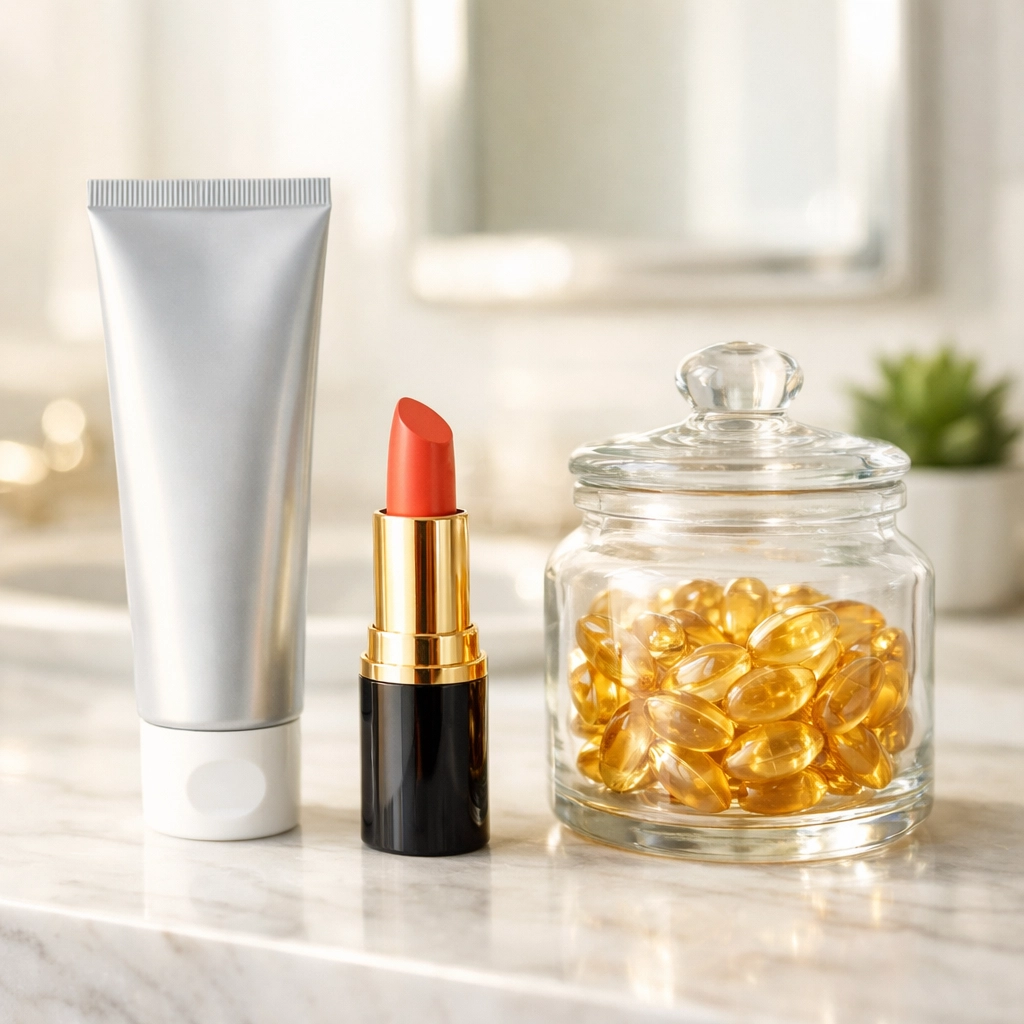
Suggested prompt: A flat-lay of various beauty products like lipstick, toothpaste, and vitamins, with a magnifying glass hovering over the lipstick, symbolizing the focus on mouth-contact items.
Hair and Body Products: The “Safe Zone” (Low Risk)
I see so many people in gluten-free forums panicked because their expensive salon shampoo doesn’t say “Gluten-Free” on the bottle.
Let’s take a deep breath.
Unless you are washing your hair with your mouth open (we’ve all had those mornings, but still…), the risk of shampoo or body wash causing an internal autoimmune flare is incredibly low. For most people, “gluten-free shampoo” is a luxury, not a medical necessity.
However, there is a catch. If you have young children who might drink the bathwater, or if you have a skin condition like eczema that leaves your skin “broken,” you might want to be more careful. But for the average warrior? Your shampoo is likely not the reason your antibodies are high.
I’ve written about the emotional toll of these daily decisions in my post ↑ Supporting My Wife Through Hashimoto’s. It’s about finding the balance between safety and sanity.
The Safe Product Checklist
To make this easier, I’ve put together a quick checklist for your next bathroom audit. Don’t feel like you have to do this all today. Take it one step at a time.
- Step 1: The Mouth Check. Check your toothpaste, mouthwash, and lip balm. If they aren’t labeled GF, put them at the top of your “to-replace” list.
- Step 2: The Supplement Audit. Look at your daily vitamins. Look for wheat, barley, or rye in the “other ingredients” section.
- Step 3: The Hand Trap. Check your hand lotion and hand soap. Why? Because we eat with our hands! If you apply gluten-filled lotion and then pick up a gluten-free cracker, you’ve just cross-contaminated yourself.
- Step 4: The Hair/Body Relax. If your shampoo contains “wheat protein,” don’t panic. Finish the bottle, and if you feel better switching to a GF brand later, go for it.

Knowledge is Your Shield
The goal of The Wandering Quill is to make this lifestyle easier for you. I want it to be sustainable. If we spend all our time and money worrying about the 1% risk in our shampoo, we have no energy left for the 99% of things that actually help us heal, like eating nourishing foods and managing stress.
I know how overwhelming this is. I’ve watched Tammy navigate these waters, and I’ve seen the frustration when things don’t “just work”, much like my tech issues today! But just like I eventually got those servers to talk to each other, you will get your routine down to a science.
Focus on the Mouth-Contact Rule. Protect your internal environment first. The rest is just details.
If you’re looking for more guidance on how to navigate the lifestyle side of things, check out our full collection of ↑ Gluten-Free Resources. We’ve got your back.
Tried & Tested
At The Wandering Quill, we don’t just write about this stuff; we live it. Every tip, rule, and recipe shared here is used in our own kitchen and bathroom. We’ve tested the “mouth-contact” approach in our own lives to see what actually moves the needle for Tammy’s health and what just causes unnecessary stress. We personally test everything so we can answer your questions with honesty and heart.
Medical Disclaimer: I am not a doctor, a nutritionist, or a medical professional. I am a husband and a creator sharing our lived gluten-free experience and the research we’ve gathered along the way. While I strive for accuracy, please do your own research and consult with your medical team before making changes to your healthcare or supplement routine.
You’ve got this, warrior. One label at a time.