
If you’ve recently sat in a doctor’s office and heard the word “Hashimoto’s,” you know that heavy, sinking feeling in your chest. It’s like being handed a map to a country you never wanted to visit, and the ink is already starting to smear. For many of us, that diagnosis is followed by a flood of advice from the internet, well-meaning friends, and medical professionals, much of it contradictory.
The biggest question usually hits about three days after the diagnosis, usually while you’re staring longingly at a loaf of sourdough: “Do I really need to give up gluten if I don’t have Celiac disease?”
It’s the great Hashimoto’s diet debate. On one side, you have the strict clinical guidelines that often say, “If your Celiac test is negative, keep eating the bread.” On the other, you have a massive community of warriors who swear that putting down the wheat was the single most important step in reclaiming their lives.
My wife Tammy and I have lived in the middle of this debate for years. We’ve seen the confusion, the heartbreak of “failed” lab results, and the sheer joy of finally feeling like a human being again. Today, I want to talk about why going gluten-free (GF) is often the secret weapon for Hashimoto’s, even when you’ve been told you don’t have Celiac.
Beyond the Celiac Label
For a long time, the medical world viewed gluten sensitivity as a binary: you either had Celiac disease (an autoimmune reaction that destroys the small intestine) or you were fine. But those of us on the front lines know that health is rarely a “yes/no” checkbox.
There is a vast, often misunderstood space called Non-Celiac Gluten Sensitivity (NCGS). You might not have the specific genetic markers or the intestinal damage that defines Celiac, but your body is still sounding the alarm every time you eat a bagel. When you have Hashimoto’s, your immune system is already “hyper-aware.” It’s looking for threats, and for many of us, gluten is the ultimate provocateur.
We’ve found that focusing on how you feel is often more powerful than a piece of paper from a lab. If you’re struggling with brain fog, joint pain, or that “hit by a truck” fatigue that Hashimoto’s loves to bring, your body is telling you something. Listening to that voice is the first step in our shared journey toward wellness.
↑ Explore our resources for navigating the Hashimoto’s journey here.
The Science of “Mistaken Identity”
One of the most compelling reasons to consider going GF with Hashimoto’s is a concept called molecular mimicry. Think of it as a case of mistaken identity at the microscopic level.
The protein in gluten, called gliadin, has a molecular structure that looks strikingly similar to your thyroid gland’s tissue. When you have a “leaky gut”: which is common in people with autoimmune issues: these gluten proteins slip into your bloodstream. Your immune system sees them, recognizes them as an invader, and goes on the attack.
The tragedy is that because the thyroid looks so much like the gluten, the immune system gets confused and starts attacking the thyroid too. It’s like a soldier firing on their own camp because the uniforms look too similar. By removing gluten, you’re effectively taking away the “trigger” that keeps your immune system in a state of high alert.
Extinguishing the Fire
When we talk about Hashimoto’s, we’re really talking about inflammation. It’s the fire that burns in the background, making everything from your mood to your metabolism feel “off.”

Gluten is a known inflammatory trigger for many people. Even if it doesn’t cause an immediate “bathroom emergency,” it can contribute to systemic inflammation that flares up your thyroid antibodies. We’ve spoken to so many people who saw their antibody numbers drop significantly after just a few months of going GF: not because they cured their Celiac (which they didn’t have), but because they extinguished the fire.
Knowledge Is Power
Understanding the gut-thyroid axis is a game-changer. Your gut is home to about 70-80% of your immune system. If your gut is unhappy, your thyroid is going to feel the heat. Many people with Hashimoto’s also struggle with low stomach acid or nutrient deficiencies (like Selenium and Zinc), which makes processing tough proteins like gluten even harder.
When Tammy and I first started this transition, we didn’t just “cut things out.” We started looking at what we could add to help the gut heal. Bone broths, fermented foods, and plenty of colorful vegetables became our new best friends. It wasn’t about restriction; it was about resilience.
↑ Discover our favorite gut-friendly and gluten-free recipes here.
Lessons from the Kitchen Table
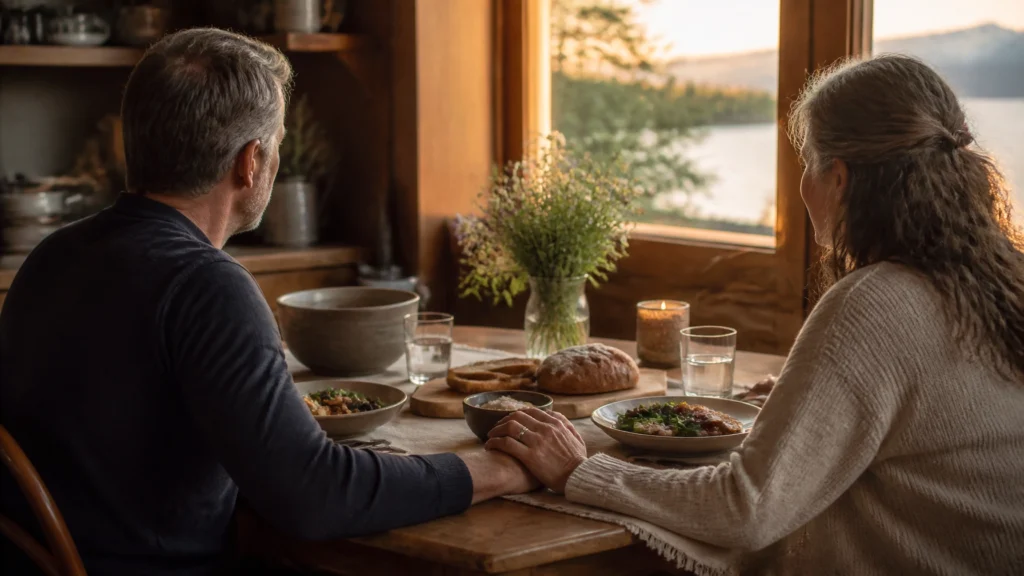
Let’s be real: the transition isn’t always easy. I remember the first time I tried to make a gluten-free loaf of bread. It looked like a brick and tasted like a sponge. We laughed (and cried a little), but that’s where the “Wandering Quill” spirit comes from. It’s about the practice, not the perfection.

One of the biggest lessons we learned is that you can’t do this alone. Whether it’s your spouse, a friend, or an online community, you need people who “get it.” People who won’t roll their eyes when you ask the waiter a dozen questions about the sauce.
We started treating our kitchen like a laboratory of love. We experimented with almond flour, coconut flour, and cassava until we found the “sweet spots” that made us feel like we weren’t missing out. When you realize that you can still have a delicious, crispy pizza or a moist muffin, the “deprivation” mindset disappears. You start to see these choices as victories for your health.
Facing the Skeptics with Strength
You will encounter skeptics. Some might be doctors; some might be family members at Thanksgiving. They’ll point to studies that say “there’s no evidence” for a GF diet in non-Celiac cases.
When that happens, remember: You are the expert on your own body.
If you feel more energetic, if your joint pain vanishes, if your hair stops falling out in clumps after you stop eating gluten, that is your evidence. We’ve learned to advocate for ourselves with kindness but firmness. We aren’t being “picky eaters”; we are warriors protecting our health.

Victory in the Small Things
The “debate” might continue in the medical journals, but for us, the verdict is in. Living gluten-free has given Tammy her life back. It’s given us more mornings where she wakes up feeling rested and more evenings where we can go for a walk together instead of her collapsing on the couch.
If you’re on the fence, I challenge you to try it for 30 days. Not as a “diet,” but as an experiment in self-love. Track your symptoms, watch your energy levels, and see if that “mistaken identity” in your immune system starts to settle down. You might just find that the best version of yourself was waiting just on the other side of that wheat-free threshold.
Love Is in the Details
Success in this journey is found in the small, daily decisions. It’s in reading the labels on your spices (did you know some have wheat fillers?), choosing the restaurant that actually understands cross-contamination, and celebrating every “good” lab result like it’s a gold medal.
We are all in this together. This isn’t just a blog; it’s a community of people who refuse to let a diagnosis define their potential. We are living proof that you can thrive, eat incredibly well, and feel powerful, even with an autoimmune condition.
“The greatest discovery of any generation is that a human can alter his life by altering his attitudes.” : William James
Want to share your journey?
We love hearing from our community! Whether you have a question about a recipe or want to share your own Hashimoto’s victory, drop us a message or leave a review. Your story might be the inspiration someone else needs today.
Martin & Tammy
Tried & Tested
We want you to know that every recipe and tip we share comes straight from our own kitchen. We personally test everything: from the texture of the bread to the ease of the meal prep: so we can answer your questions with total honesty. We’ve lived through the “kitchen disasters” so you don’t have to!
Medical Disclaimer: We are sharing our lived experience and the knowledge we’ve gained on our own gluten-free journey. We are not doctors, nutritionists, or medical professionals. Always do your own research and consult with your healthcare provider before making significant changes to your diet or treatment plan.